Saturday, May 28, 2011

Argument and the blogosphere

One of the many great things about New Media is the exchange of ideas to be had by bringing people from different backgrounds together. I think that there is a place for genuine dialogue and growth to be found out here on the Interweb.

But isn't it annoying when you get a response from your so very well thought-out post that is the equivalent of "your clothes are ugly, and you smell"?

In that spirit, I was much appreciative of one of the latest installments on "The Art of Manliness": Classical Rhetoric 101: Logical Fallacies

A Teaser:


Hope you enjoy.

Wednesday, April 6, 2011

TLM in Raleigh, NC!

Being home in North Carolina, we are most fortunate to be in a slightly more populated area than the Diocese of Cheyenne-- for instance, there are quite a few parishes here in Raleigh, whereas in Wyoming, we'd have to drive 2 hours to get to the next nearest parish, and 3 to get to one of the only places where Mass is offered in the Extraordinary Form (@ Wyoming Catholic College), and even there, much to the chagrin of many folks in the diocese.

So we were most pleased to find that the Diocese of Raleigh has done a very good job of implementing the Motu Proprio, with the full support of His Excellency, Bishop Michael Burbidge (see his letter of Implementation of Summorum Pontificum), and a strong diocesan presence, with six parishes in the diocese regularly and publicly offering the Mass of the Ages. (I say publicly, because I know of several priests who also celebrate it privately)

When I left Raleigh to go overseas to work for the Church, Bishop Burbidge had just been installed (2006), and 5 years on, it is good to see the work he has done, especially with regard to the liturgy, to help bring the diocese along with a proper implementation of the Council, employing a hermeneutic of continuity.

Kudos to Bishop Burbidge and the many priests who offer the traditional Mass to the people of the Eastern half of the Old North State!

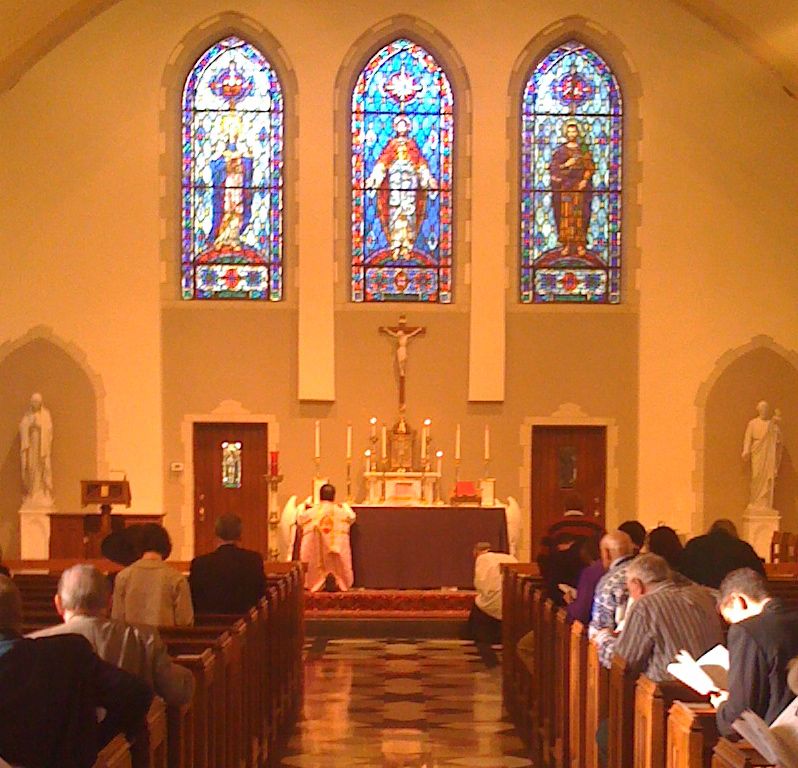
Notably, the mass we attended was at the Cathedral, which offers the usus antiquior on the First Sunday of every month. It was a Low Mass, but with a schola present to provide music in appropriate places. The schola, Schola Vox Clara, apparently travels around the diocese, singing for many of the Masses here in the diocese! With a schola available to sing the parts of the Missa Cantata, it shouldn't be too long before the celebrant is able to offer one, as that is the hardest part taken care of.

The priest-celebrant, Fr. Walter Ospina-Briceno, was a lovely man, who gave an insightful homily, and we had a great conversation with him after Mass. As it was Laetare Sunday, he spoke briefly about the meaning of Rose as a liturgical color, and how such things in the liturgy have a sacramental nature. There were 90 people in attendance at the Mass, which has been stable for quite a while now, so it is evident that the cathedral is indeed setting some best practices for the rest of the diocese.

As we have a new baby, I spent a bit of time in the porch of the church, which allowed me to get a few photos of the Mass itself. Many apologies for the quality, as they were taken on my (original version) iPhone.

(also-- note the cathedral itself. the altar rails are brought in specially for the Mass, but one of the many things His Excellency did after arriving was to instruct that the tabernacles in all of the churches of the diocese be brought in to a prominent location, if not the center of the church. In the cathedral, the tabernacle used to be over to the left-hand side, beside the pews.)


during the homily
during the Canon
during the Last Gospel
Server's blessing after Mass
Father, your blogger, and a future priest(?)
     
I must confess, I am rather disappointed that this is the only traditional Mass offered in the capital city a month! We were lucky to be here the one weekend it was offered. Hopefully, please God, as the EF becomes less and less a novelty, that problem will be solved. And, perhaps His Excellency would consider learning it, so as to be able to offer Confirmations, and even a Pontifical Solemn Mass one day?

One thing I wonder about, at least, based on the one Mass that I attended, is the growth in altar servers to serve the Mass. There was only one server for this Mass, and he wasn't a youth (no offense). Given that there's only one public Mass a month in the Raleigh area, it makes sense that there wouldn't be many servers, or even youth, to serve it. This seems to me of principle importance for vocations, and I hope that as the community here continues to grow, then that aspect of formation will be attended to.

In the meantime, kudos to all of those who are working so hard in the diocese to grow this community and keep it thriving! Be assured of my prayers, and I ask you readers to take a half minute and pray a hail Mary for them.

For more information on Schola Vox Clara, visit here.

For more information on Traditional Masses offered in the Diocese of Raleigh, visit here.

Monday, April 4, 2011

Back from Blogging Break

So sorry to take a short break from blogging-- my wife has been writing an essay on Grace and the Trinity for her MA, and then also preparing for exams! Needless to say, I have been taking every free moment to take care of the baby so she can be free to study, and of course, still manage-- barely-- to get all of my work done for the parish: what a busy time!

Now we are taking a much needed vacation! We have used Spring Break as an occasion for coming back to visit my family and friends in North Carolina. What a great trip so far! We haven't been back here since the wedding, and so it has been a great opportunity to introduce the baby to everyone, and to eat some good southern cooking! Friday night, we went to the oyster bar and had steamed oysters; Saturday night, we had Eastern North Carolina Pork BBQ, and then Sunday had a nice dinner at the Irish pub I used to work at ages ago. Today on the menu we have a little hole in the wall called "Pam's Farmhouse". It doesn't look like much from the outside (or on the inside for that matter), but when you pull up at lunch not to be able to get a seat, and notice all of the state-owned vehicles parked outside, you know you're in the right place. I can't wait!

Right, well, being back in the Bible belt has been the occasion for more than one blog idea, so be sure and check back to see what has been going on!

God bless!

Wednesday, March 16, 2011

Happy St. Pat's Day!

Céad Míle Fáilte, and a Happy Feast Day to all!

Once upon a time, in a previous life and in a galaxy far, far away (a place called North Carolina), I worked at an Irish Pub for quite a long time. It was a very formative period of life, and I learned not a few lessons during those five years.

Most of all, I learned exactly how to celebrate St. Patrick's Day-- properly speaking, the festivities would have begun last weekend, and will end sometime next week, or whenever the Guinness runs out. That typically doesn't happen, though, because, let's face it, that's just poor planning.

Anyhow, that's neither here nor there. One thing that I miss terribly about the good ole days at the Pub is just the community and the goodness of those in the Irish community. Whether at a céili, or a sunday afternoon session of players, or an all out feis, what a great group of people the Irish are to be around-- and, Irish or not, you're always made to feel welcome. If you happen to be in North Carolina tomorrow, I'd highly recommend stopping in at this pub for the craic:

---

On a related note, our youth group met tonight, and we showed them a great video all about that great evangelizer of Ireland-- I though I would post it for your benefit:


Sláinte to you all, and enjoy a sweet pint of the Black Stuff today!

Tuesday, March 15, 2011

"One Day" About Catholic New Media...

I don't know whether you saw this or not, but today is the day! Happy Catholic New Media Day!

Today is the day we're supposed to get the word out about Catholic New Media... sooo-- do your part!

The request was that, as a part of Catholic New Media Day, we post our favorite three blogs.

Here are the three that I check every day, and always have good things on them (though, I must confess it's hard to choose three):


Fr. Z's blog is a mixture of things, but usually the posts revolve around the renewal of the Liturgy. The title of the blog comes from his regular contribution to the newspaper, "The Wanderer," where he takes a prayer for an upcoming Mass and gives a history of its use, as well as a "slavishly literal" translation of the Latin, then comparing that to the "lame-duck" ICEL translation.


The Archbold brothers write this blog together. Let me tell you, I laugh so hard when I read this blog. Sometimes I nearly spew my coffee, too. They are a good read for the latest in Catholic culture, and life. Sometimes they push the envelope on what my own Catholic senses tell me is "acceptable"-- but I think that serves me as a reminder of what it is to be "real" and Catholic at the same time. If I had enough guts, I'd write like that, myself.


Fr. Tim Finigan, parish priest in Black Fen, outside of London, is the blogger here. I met Fr. Tim when I worked at the Maryvale Institute in Birmingham, England. He is a very holy priest, and gives a phenomenal take on the issues of the day from the perspective of a parish priest. Very often, his posts revolve around what is happening in parish life-- what a beautiful witness to the lived traditions of our Faith! His blog title comes from Pope Benedict XVI's now-famous address to the Roman Curia on the occasion of his first Christmas as Pope. (found here). He has been blogging for quite a long time now, and probably one of the forerunners of Catholics using New Media in the UK. Now that I'm not living there anymore, it's also very nice to get caught up on the latest on the Church there.


Finally, I'd be remiss without mentioning two sites that scour the Interweb for the latest in Catholic blogging:
http://thepulp.it, which is re-syndicated on NCRegister, and also
http://newadvent.org
If you ever don't know where to begin with reading blogs, check these two out!


Right, well, there's my contribution for the day-- though I am new to blogging, I am trying to make my posts substantial; I do hope that you appreciate reading my thoughts on the various things I have written about!  Oh that I could be half the writer of any of the aforementioned bloggers! If you aren't aware of them, please visit their sites.

Stay tuned for some other things over the next few days-- I have one or two posts in the works!

God bless you, and... beware the Ides of March.

Wednesday, March 9, 2011

Extraordinary Lenten Penance-- offbeat

"And when you fast, be not as the hypocrites, sad. For they disfigure their faces, that they may appear unto men to fast. Amen I say to you, they have received their reward." Matthew 6:16

A very happy Ash Wednesday to all of you!

I do hope that with the beginning of Lent, you have solidified your plans for prayer, fasting, and almsgiving. If you're still looking for ideas, I thought that, in the spirit of the scripture verse, I would offer a cheerful one:

Here is a gentleman who is doing a Beer-fast for Lent. Now, before you write him off, watch the vid:


God bless him-- I think it's a great aspiration, and I'll be following his daily progress to see how he's doing. Although he's not a Catholic (as far as I can tell), I have great admiration for his desire to keep a traditional Lenten penance in his own way.

As a homebrewer myself, I think the idea is intriguing, though I would not necessarily want to do that as my Lenten penance. Having done one or two extended fasts before (more than a day, but not a week), I have great sympathies for his endeavor-- it will be a difficult one, for sure! Please say a prayer for him, and if you want to follow along with his Lenten journey, visit his blog:

In fact, so as to be in solidarity with the gentleman, I think that I will brew a doppelbock this Lent. I wonder if they would share their recipe?

In the meanwhile, have a wonderful day, and God bless you all!

Friday, March 4, 2011

The Role of Music in the Implementation of the New Missal

A major effort is being made to ensure that, alongside of the proper implementation of the words in the 3rd edition of the Missal, the music to accompany the Mass is being given the same attention.

Much of this is owed to those who work tirelessly in parishes and dioceses, but also through organizations such as the Church Music Association of America, in order to bring about an authentic renewal of church music.

An example of this perceived "new" importance placed on music is in the layout of the new Missal: a departure from the current edition of the Missal in the fact that the chant tones for the Mass that the priest can sing will actually be in the "Ordinary" section of the new Missal, rather than as a seeming afterthought, stuck in an appendix to the current Missal.

Now, I'm sure that most of us realize that if there is anything in the Mass that resonates on such a subjective and personal level for the congregation, it is the music. For that reason, substantial change to the music in a parish almost always causes enmity and discord.

The aim of the Church in this area is to ask the question, "Is it one--does it convey the unity of God? Is it true-- does it well express the mysteries of God? Is it good-- does it elevate the soul toward virtue in God? Is it beautiful-- does it lift the heart to contemplate the perfection of God?" and, by asking these questions, to evaluate the music's suitability for the liturgy based on objective criteria. How do we work to change the stigma surrounding "traditional" music, alongside of the real challenge our pastors and bishops face in the shifting of such a paradigm?

My colleague in the parish here where I work, Mr. Francis Koerber, has written a book to help assist with the implementation of the new Missal. Entitled, "What Should we be Singing Now?" it is a free e-book (though, you can order hardcopies) designed to bring together all of the current legislation on music and the Mass, in order to propose an ideal toward which we should all be working in re-introducing the music so venerable to the Roman Rite back in to the celebration of the liturgy.

I think that it is a phenomenal contribution to the ongoing discussion of implementation, especially the rather wrong-headed notion of "inculturation" that we have seen in so many parish music programs since the Council. (Every time I hear "The Canticle of Turning," I can't help but think of the Irish drinking song from whence the tune was borrowed...)

In a truly pastoral way, Mr. Koerber uses quotes from such persons as Pope Benedict XVI, Francis Cardinal Arinze, and Msgr. Guido Marini to reinforce what the Church has consistently taught in the area of music and the Mass.

In addition to solid teaching on the purpose and orientation of sacred music in the liturgy, Mr. Koerber also shares a wealth of free resources which he has compiled from various authors, all free and in the public domain available over the Internet.

Utilizing these resources alone makes it possible for a music director in a parish to very easily implement the music of the Mass--the actual words of the Mass for a particular celebration--through the use of the Propers; and also to use an objective criterion for selection of hymns, and discern when they are and are not appropriate to use at Mass. These resources would be an invaluable collection, whether one be a volunteer musician in a small mission church or a full-time director of music in a cathedral. Indeed, our diocesan liturgy committees would also benefit from these resources in developing a unified pastoral plan to support the parishes of the diocese.

One of the more appealing aspects of this book and the resources, to me, is the fact they're all free to use and in the public domain. There has been quite a lot of contention surrounding the release of the new Missal-- specifically over copyrights and ICEL, and, as regards music, the seeming reality that three music publishers in the USA have a corner on the market, thus limiting the ability for others to write music as an alternative to what they publish, all because of the copyrighted nature of the words of the Mass in English.

The fact that, for no more than the cost of an Internet connection and some ink and paper, we can elevate the quality of the liturgy through the use of the music so venerable to our patrimony in the Roman Rite, seems to me a win-win-win scenario.

I highly endorse this new venture by Mr. Koerber, already a renowned composer, and now having written a book that will assuredly be of great assistance in the pastoral planning and direction of Catholic music in the implementation of the 3rd Typical Edition of the Roman Missal, and indeed, for the next generation of Catholics.

To download the book, please visit: http://www.RomanCatholicSacredMusic.com/wswbsnB2.pdf

Tuesday, March 1, 2011

Catholicism and American Culture: A question of Immigration and Integration.

Rocco Palmo has some great coverage over at Whispers about the transition of Cardinal Mahoney to Archbishop Gomez over in L.A.-- I'd encourage you to go read it. What a tremendous day for the Archdiocese of L.A., and the beginning of a new era for the Church there. Read the articles here, here, here, and here.

In reading the last one, though, the quote particularly struck me, and I couldn't help but be really put off by it. Here it is:
"Este es un gran día para el Catolicismo Americano. Hoy ya los latinos no somos católicos de segunda -- ¡somos católicos americanos!"
Translated:
"This is a great day for American Catholicism. Today, we Latinos are no longer second-class Catholics -- we are American Catholics!"

(Does this quote not have similarities to sentiments expressed by African Americans in 2008...?)

Stop right here for a second, and think about the implications of this statement, and just how wrong-headed it is...
...
...
...
...

Okay. FIRST, where in the world have latinos ever been considered second class Catholics? I can think of no place. In fact, latino culture is almost synonymous with "CATHOLIC"-- capital letters to show that they are actually the epitome of what it is to be described as a Catholic. Indeed, being latino is so closely associated with being Catholic, that even pop culture has got it nailed. Take Jack Bauer of 24, who gets a tattoo of Our Lady of Guadalupe as his sign of initiation in to a mexican gang in season 3. (let's forget the negative caricature here, and move on).

The problem I have with this statement is that it confuses religion with a secular national culture; the problems associated with this secular culture(i.e. American life and politics) do not necessarily equate with problems in a religious culture that happens to operate in the particular secular culture.

The individual making the aforementioned statement has made the foregone conclusion that being Catholic in America necessitates that the Church is implicated in the problems of the national culture-- indeed, in some way has to answer for the problem. For my part, I am a Roman Catholic who happens to live in America; I am not an American cathlick.

In America, there is definitely a political debate over how to solve the increasing problem of immigration. Undoubtedly, this is a problem that the Church has to address by coming up with creative solutions. However, the mission of the Church, whether to anglos living in South America, or latinos in the USA, is the same one: the salvation of souls. This mission simply needs to be adapted to the particular culture.

I would argue (and I think it's a sound one) that the Church herself does not discriminate against latinos. Although I do recognize there are probably prejudices in individual communities to greater or lesser extent, which affects parish life: why is that? Certainly, it's not because the Church labels them as "second-class Catholics".

So why this statement-- one with such a negative connotation of what the Church has done to/for Latinos living in America? Could we be seeing a distortion of the nature of the Church, perhaps influenced by the erroneous notions of liberation theology, so prominent in latino culture? The notion being one of an "immanent church," a church existing solely to give equal rights to the poor and marginalized, and build up the kingdom on earth?

I think that this quotation is actually not at all about being considered a "second-class Catholic." Aside from the question of politics and immigration, I think that the perceived injustices upon those in the hispanic community are a result of the same problem that is plaguing the anglo community in America. No vocations. Though, perhaps in this instance, the problem resulting from a lack of vocations is being blamed upon this non-existent entity, "the American church," who hasn't been doing enough for the latinos.

As a result of this vocations problem, the Catholic Church in America is dealing with an increasing shortage of priests, and then on top of the pastoral needs of the "anglo community," the hierarchy feels they have to take care of an entirely separate culture's needs as well. (Is it a separate culture, truly?) What we have here is a question of cultural integration, complex to be sure, but to which the Catholic Church historically is ideally suited to present a solution.

Based on my own experience, and solely my personal opinion, I'd like to present a few proposals for meeting the needs of the hispanic community, if they indeed desire to continue to exist as a separate community. These proposals are intended as an alternative to the current model, where the needs of the community are being met by those from outside the community. (warning, they may be "controversial"). They're in ascending order of short-to-long-term solutions.

The hispanic community as a whole, or representatives from that community, should consider:
1) learning English (is having a Mass in spanish integral to a Spanish Catholic cultural identity? It wasn't for quite a long time before the 70's); 2) bringing a priest with them; 3) encouraging vocations within the community; or 4)all of the above.

The problem is, from my perspective, that the Catholic Church in America has adopted the US government's response of accommodation of immigrants, without any expectation that they take on some of the responsibility of "being Church"-- something about that 5th precept comes to mind. In my own parish, there are zero hispanic parents involved in catechesis, despite my repeated efforts to recruit volunteers. And yet, our first communion class is full of hispanics. Granted, this is most likely due to a culturally different understanding of how catechesis is done, but if that is the case, we aren't seeing catechesis being done through the home or by any other means within the hispanic community, either. (This is not the place to get in to the Americanchurch catechetical model, but I am not a proponent of it, either)

In all of this, I have to wonder whether there is truly a spanish-language "need" to be met in the Church today, at least through the providing of the Sacraments.

I can't help but postulate whether or not the notion of "the American Church" wasn't furthered along by the de-railing of the desired liturgical reforms of the Second Vatican Council. With the impetus of Mass entirely in the vernacular (which wasn't called for by the Council), we see also the segregation of what it means to be "Catholic". 

To be Catholic, one now has to know the language in which the Mass is said. One now has to attend a Mass in their own language, where the emphasis on gnosis is primary. Alongside of the emphasis on the immanent community experience, there has been an overwhelming loss of that which is transcendent in the Mass; namely, communion and relationship with God. (as evidenced by the overwhelming lack of belief in the Real Presence by Catholics today)

At least in the so-called "Tridentine" Mass, the "needs" of the latino population for Mass would have been met. Simply order a latin/ spanish missal to stock in the pews. Granted, there are still pastoral needs, hence the desire for priests who speak Spanish, but is that the responsibility of the anglos to provide? And on a related note, because this is the example brought up most often: does one "need" to understand the language to hear confessions and offer absolution? Is therapy what the Sacrament is about?

Please read: I'm not advocating that latinos shouldn't be able to have their pastoral needs met by someone whom they can understand and relate to with a common cultural experience and who speaks the same language.

What I'm suggesting is that, barring they don't meet any of the 4 proposals I made above, should it be the responsibility of those in America to provide a long term need for an entire community? It seems that, at some point the community, if it wants to remain a "separate" community, needs to start providing for itself.

The USCCB, or even the priests of a diocese, need not be "American." The simplest requirement for membership as a priest of the diocese or as a Bishop of the USCCB is that of doing ministry in the geographic location. If latinos want their separate culture, then perhaps we need to be thinking about how priests and bishops are brought in from other places.

But, as I said, I wonder whether this "need" is a legitimate one. I don't like the idea of "two communities" in one parish. It seems to me that a more pastoral approach, a more "Catholic" means of building unity, "a more perfect way," if you will, would be to have Mass in Latin, which would bring the whole community together to share in the one Mass as one community. This idea of bi-lingual Masses are an aberration, and only serve to make everyone annoyed. The Church's tradition already offers the perfect solution for unity: why not embrace it?

These are complex problems, but they needn't be. They are getting more complex, most likely because of our own actions, and these actions keep digging us deeper. At some point, we will have to embrace what it is to be Catholics of the Roman Rite, to further define what "rights" we have as Catholics who happen to live in America, and to come up with realistic solutions to these pastoral needs, so that we can sustain the system long-term (ex. I've already alluded to it, but do we have a "right" to Mass in the vernacular?). Integral to that, if latinos want to have their pastoral needs met in spanish, there has to be an increase in vocations from the community to support the community.

But maybe I'm wrong. Your comments/ opinions are most welcome-- God bless you!

Tuesday, February 22, 2011

A blogging milestone

Hello!

I thought I would write in celebration of my first milestone as a blogger-- just over 1000 visitors since I began the blog!

I must say, blogging is a lot more difficult than one would imagine! It has been difficult to balance my family life, my job, and everything else, and still find time to blog! I hope that, as I write more, it becomes easier, as well-- I don't know how people like Fr. Z crank out the volume they do!

An ulterior motive for blogging has been to keep my brain active while I am not working on my degree, and also, to work on being able to take more complex ideas and boil them down to a reasonable word-count. I hope that, so far, it has been as enriching for you as the reader as it has been for me as the writer to reflect upon these topics.

Anyway, I hope that you continue reading, and thank you so much for visiting! Feel free to pass the link along to a friend!

Be assured of my prayers for you today,

-Chris

3 "-isms", a dangerous combination

(NOTE: I have been writing this for about a week now, but how providential for the topic to be posted on the Feast of the Chair of Peter-- happy feast day!)


There's no doubt about it, the Modern Church is having an identity crisis. Just this past week, our parish had a "listening session" to try and come up with creative solutions to the clergy shortage. The usual answers came out of the usual places-- womenpriests, married clergy, etc. I find it interesting that not many people are paying attention to what is being done differently by these young traditional communities with flourishing vocations. Perhaps many view them as idealistic, and could never work in a modern parish setting. I beg to differ.

In my travels, I have noticed that there are three -isms in particular that have combined in a very interesting fashion in the West today (though, there are probably more), which I think are at the source of this crisis.

The three I am referring to are Americanism, Conciliarism, and a new form of "anti"-Clericalism. I say, a "new form," because, rather than an extreme dislike for things clerical, there is an apathy or total lack of recognition of the role of the clergy. Indeed, perhaps this new form is actually the goal toward which anti-clericalism was originally oriented-- violent emotions cause for people to weigh in and take sides; apathy allows for something to quietly go the way of the buffalo.

I think, that, in doing a proper study of the Church, we would see that these three -isms have merged in such a way that they have influenced the standard method of operating a parish, or a diocese, or even a Bishop's Conference-- though, of course, we have those outliers that rebel against this model, and are bravely and (usually) silently on the edge of things, just doing their jobs as good parish priests or Bishops.

While I won't get into the nuances of each of the -isms, I'll give a brief explanation of how I see them in action today.

Americanism (see here) as a heresy could simply be defined as a national pride which sees America (or name your country) as on the cutting edge of progress, and therefore has more of a claim to pointing the direction of the Church in the future-- indeed, to the point that they may feel Rome should take notes from them.

Really, this is the same agenda that was being pushed back in the 4th-6th centuries by the see of Constantinople, struggling to gain equal or more authority than the see of Rome. Though I don't think that the USCCB or the BCEW, etc, would ever say that this is their objective (in fact, the Bishop's Conferences in general do great work within their scope), I do think that there are many members of the Conference who would like to see something of this nature happen. The solution? trust the hierarchy established by Christ. "Tu es Petrus..."

This leads very naturally in to the next "-ism". Conciliarism was a big idea in the Middle Ages, when bishops were trying to push the Pope around. The gist is that if Bishops got together and weighed in on an issue, then the Pope would have to do what they wanted him to do.

I think we're seeing this particular "-ism" on many levels in the modern western Church. First, the notion that Bishops Conferences have real authority to make decisions that are overarching in every diocese in the realm. This can be a problem when a local Ordinary voluntarily hands over his own authority to be exercised by the Bishop's Conference. His Excellency, Bishop Vasa, now co-adjutor of Santa Rosa, addresses this very issue here:

More locally, we are seeing that in a lot of dioceses, the priests are pushing for a different notion of conciliarism, called "collegiality," with regard to how they would like their Bishop to operate. Though this call for collegiality from the Council was rooted in being more pastoral, in practice, this has become a means of reducing the local Ordinary to merely a "pal," or "buddy," who exists solely to justify what a priest would like to see done, rather than someone who has authority over his flock, and whom they are obliged to obey. Sadly, many Bishops are forced into this role because of fraction and schism in the modern Church, in order to keep the peace. (Perhaps it would be good to remind folks what the crozier is actually for!)

Still more locally, we have the phenomena of "the parish council". Meant to be a consultative body, so that the Pastor can make informed decisions, in too many places, the council is simply a means of turning in to a democratic church, where these folks are elected to tailor the Church to how they would like to see it. When a good priest tries to implement any real change for the better in these parishes, too often the "vote" is made by the offering plate, or in parishioners simply moving to another parish.

Finally, we have a new "anti-"clericalism. Clericalism is used as a pejorative in many places, but I think today we should be trying to rehabilitate the term. Misunderstanding the role of the clergy in the Church is (imho) the main cause of the aforementioned issues. In America, a traditionally "anti-clerical" country, we have empowered the laity so far as to turn the priesthood in to a function of utility. "Stand here and say Mass, Peter," "Don't worry about how the finances are being spent, Peter"-- of course, in these churches they would not even think of calling a priest "father". And we wonder why there is a vocations "shortage"?

I should point out at this point that I am in no way discounting the importance of the laity. They have a very important role in the Church, and when rightly ordered, can contribute in dialogue with the clergy in a mutually beneficial manner. The document, "Ecclesiae de Mysterio," does a very good job of laying out the very real ministry that a layman exercises, and where that line is between the clergy and the laity, which in many places has been all but erased.

At this point, I hope you too recognize that these "-isms" are not unrelated. So what is the solution to all of this madness?

Ephesians 5 comes to mind, here-- what if the bride of Christ allowed her spouse to love her so much that he would sacrifice himself for her? Are our clergy formed to see this as the relationship they have with those in their care? Modern "pastoral theology" seems to me to be missing this element, and the generations of fracturing relationships between the priest and the community have led toward a lack of respect for the priest on the part of the community.

In rehabilitating the term "clericalism," it seems that the laity have to desire to be guided towards Heaven, and to allow their father to act in a fatherly manner. Similarly, priests have to be formed to view this as their relationship with their parish, and have a pure intention toward fulfilling this mission of bringing all people to Christ.

In recognizing that these tendencies exist in the Church today, especially in those who were formed in the years following the Council, I think we should also recognize that many of the young priests and seminarians that we have today are exemplifying heroic virtue in responding to their call to the priesthood, and to be spiritual fathers. What a blessing it has been to have met so many young, holy men in my travels!

These problems will probably take decades to lose their hold on the Church, until they inevitably re-appear under another form, but I think that the best thing for us as laity to do is to pray for our clergy, to support them in their decision making, to be in deference to their decisions (whether we agree or disagree), and to earnestly desire to have that spiritual fatherhood cultivated in our parishes and in our lives.

I think that, in recognizing these -isms for what they are, and how much of an effect that they have on parish life, we will find that this is the first step toward rehabilitating an "authentic clericalism," a truly healthy relationship between priest and layman; and by doing so, the Church will in turn be more effective in her mission of the salvation of souls.

Tuesday, February 8, 2011

The Narrowing Gap Between the Church and the World


"Mind the Gap when alighting from the train". If you've ever been on the Tube in London, this is what the voice tells you to do. In the Church, we are seeing the gap between the Church and the world getting smaller and smaller. What happens when the train hits the platform?


It's hard not to notice these days-- the image of the Church in the world is not exactly a pretty one. Specifically, I think this is happening on two fronts. One from the perception of the Church in society; the other, how the society is having a negative impact on the Church.

On the first front-- have you noticed the number of films as of late that have taken specifically Catholic spiritual themes and made them popular? The exorcism movies have been on the rise by so much that they could probably take on a whole sub-genre of horror film. This will probably not bring about greater awareness of the reality of demonic activity, but will more likely have the opposite effect.

But it's not simply a popularization of explicitly Catholic themes-- there's also an adoption of sacred words and giving them profane meanings. In early 2011, the film called "Sanctum" hit the screens-- true to its name, this film has a very spiritual theme... going caving. Later in the spring we'll see a film called "Priest" coming to the big screen. Guess what-- it's about vampires. And there are priestesses.

And I still haven't forgotten how in the film "2012," all of the major religious symbols that were destroyed were Catholic, and not a single mosque touched.

But it's not only in the movies. We now have a show coming out on Fox starring "Fr. Cutie," an ex- priest who married some woman after having had some inappropriate photos taken of them while he was still a priest. Sounds like a great show to help solve the world's problems. (for more info, see here)

Now, just as I'm writing this, the Red Bull commercial has come on about the young man going to confession about chastity issues, then coming out of the confessional and saying to his mate, "I got two new leads"... 

Perhaps I'm hyper-sensitive to it all, but I don't think I'm being paranoid by thinking that the intrigue and popularization of this Catholic imagery being used in the media only serves to give people the impression that spirituality is nothing more than the stuff of fiction-- that having faith is something to joke about in our more enlightened "culture." That we should be grounded in the stuff of the modern world, rather than a spiritual life, and that subconscious spiritual itch can be scratched by our encounter with "spirituality" in the media, which is convenient because we tune into it when we want, then turn it off when we're finished.

On the other front, in the post-conciliar years we've seeing secular culture flooding through the church doors and in to our worship. In an attempt to be relevant and engaging to people, we try to be hip and have "contemporary music"-- music with words that are ambiguous at best, heretical at worst. Secular music is used with new lyrics to try to make singing at Mass popular; meanwhile, all I can think is that I heard that while drinking a pint of Guinness at the local Irish pub! (Compare this song with this song.)

Rather than talk about the holy sacrifice of the Mass, we talk about "sharing Eucharist," and inviting non-Catholics to receive communion, because "really, we're all one". We prematurely canonize the dead as symbolized by the wearing of white vestments at funerals, and, under  a guise of being pastoral, take liberties with the Gospel to speak of how it is they who have gone on ahead to prepare a room in Heaven for us! My understanding was that is what Jesus did. Perhaps I was wrong...

I was appalled over Christmas to see how people-focussed the Mass is in some places. There is more of an emphasis on community than on the Eucharist. The sign of peace has become an opportunity to catch up on all the news with your neighbors... need we remind you that Christ is present on the altar?

And it's a wonder we aren't getting vocations in this climate? What boy in their right mind wants to commit his whole life to Christ, when the image of God he sees is completely irrelevant to his life? These youth don't see the difference between going to Mass and going to the movies-- both are for entertainment... except, of course, the movie is more entertaining.

What we need to be working on is being a sign of contradiction. There's a reason for smells and bells and gregorian chant-- they're all sacramental... they point to the Other that is Christ. The beauty of our liturgy and pattern of Catholic daily life is that, though we live in the world, we strive for something that is not attainable in the materialism of this earth. In being this sign, it is a reminder to those who attend Mass who they are made for, what their destination truly is. Sure, there is a place for inculturation, but not to the detriment of the sacred nature of the Mass.

I really believe that the issue of liturgy will be the issue of my lifetime. Hopefully, please God, my requiem will be in line with a hermeneutic of development in continuity. If we get this right, then everything else will fall in to place. If we don't, then... ?

Sometimes I wonder if all of this effort to "be hip" (yes, I realize that phrase isn't "with it" anymore-- that was the point) is possibly because those folks who push the hardest for all of this innovation are on some level ashamed of the Catholic Faith-- ashamed to the point where they have to dress it up and make it look appealing. The paradox being that this is not what people want, anyway.

We can't do much about the secular media directly, but perhaps if our own perception changes, then the image they portray of us will begin to change, as well? Bring back the days of films like "I Confess" is what I say. When priests were real men, heroes even. How many people see our priests like that anymore-- as heroes? Certainly not many with films like "Primal Fear" being more akin to what the media wants to portray them all as.

Anyway, to bring the metaphor back round: a train and a platform both have their purposes-- they are a means to get you somewhere, and we need them both. But... we should be careful about how far one extends beyond its own boundaries, lest we create a wreck of the whole thing. "Mind the Gap."

Saturday, February 5, 2011

SWLC-- Final Thoughts.

Greetings from the final morning of the Southwest Liturgical Conference in Salt Lake City!

Well, it's not quite over yet, but I think that I have come to my conclusions about the conference. It was definitely worth coming, if only to better understand the problems. (and, it gives me blog topics for a while!)

I have had quite a few conversations with folks while here, including several people from my diocese. They might consider me to be "conservative," but I hope that, in charity, they can see my perspective as I have seen theirs.

Here's the thing. Everyone here has the same goal: renewal of the liturgy, that Christ might be not simply made present at Mass, but that we might be changed by that encounter with him. Unfortunately, many of the folks here think you do that by evoking an emotional response in the participant at Mass, or by trying to make it relevant, or respecting local cultures to the detriment of the culture of the Mass.

As for me, I'm looking at all this more theologically, rather than sociologically, or psychologically, etc. From my perspective, the Roman Rite does not need our fiddling in order to bring someone in to a real encounter with Christ. It does, however, need constancy and fidelity.

It finally hit me yesterday during a talk by Dr. Jane Regan from Boston College. She didn't talk very much at all about the Missal, but rather, people. She talked about how to do adult formation, and formational principles. It was all very good and all, and I even got a few ideas for our own adult formation program.

Here's what hit me: people need baby food before they can have a steak.

There's no way to dialogue over the transcendental nature of the Mass, or that music isn't a matter of taste, or that, in humility, we should bend our will to what the Church says, when, in the case of many of these folks, they're still on baby food.

These are the people who are standing during the Eucharistic prayer, playing feel good music on the guitar, trying to figure out how to involve more women, etc. Once I realized that its just baby food for most people, I was really able to stop being so critical, and just appreciate that, though a difference of experience and perspective, we have similar goals.

Whether it should be or not, the Church in the post-conciliar decades has been almost as wide as it is deep. The object, it seems, is that, especially with regard to the liturgy, we should be working with the Holy Spirit to turn that wideness into a funnel-- that's the only way to get to heaven, after all.

This wideness stems from a wrong-headed notion of inculturation, or the need to make the Mass relevant, or whatever good intention that people start off with. Unfortunately, it's wrong.

During one conversation, I posited that music is not about taste. It's about beauty, which is an objective quality. If there is such thing as more beautiful, there unfortunately has to be such thing as less beautiful. But we should take heart, because that also means there is something called most beautiful, and that is what we call God.

Many of the folks here are happy to talk about principles, and find that we come to agreement on them. Unfortunately, it's taking principles to praxis that is where the conflict begins.

In some ways, this makes me ever more critical of the main presenters. Their job, and the job of the organizers, is to be good stewards. They're not to be innovators, not pushing theological opinion on various topics (I still stand firmly by what I said after the first night), but simply baby food-- catechesis, not theology.

For example, how does singing the Mass, rather than singing at Mass, bring people in to a more full, conscious, and active participation in it? How is this different from hymn singing?

What is it that the rubrics call for in this situation-- why is it that, in humility, we should follow what the Church says here, rather than try and be "pastoral"? Is it truly pastoral to lead folks away from what the Church has to say?

All in all, the week has helped me to see the work to be done. I am by no means a "true believer"!  I have sat it out from the "worship" whenever I could, because of the overly horizontal nature of it all.

But the week has helped to "human-ize" those on the other side, and realize that they're not intentionally out to ruin the Church-- they're trying their best... they can just do better. And so can I, for that matter.

I think that I would much more appreciate an academic get together of folks who were able to engage at a deeper level on the subject. I wonder whether we'd have liturgies like we have had this week at that kind of gathering... something tells me probably not.

Right, well, it's almost time for the last session-- until next time, God bless!

Thursday, February 3, 2011

SWLC Day 1.

Okay, hello again!

Today has been very interesting. 

I skipped "morning prayer" because I thought it would be an occasion of sin for me, especially after last night's experience. I was told that it was probably a wise move.

Anyway, the first plenary session of the day was by Dr. David Fagerberg, a professor from the University of Notre Dame. The topic was "Being Formed into a Liturgical People by an Abiding Lex Orandi". I was blown away at the contrast between last night and today! This talk was PHENOMENAL, and I  ended up taking a ton of notes. I also had the opportunity to speak with the presenter afterward.

The most interesting thing is that Dr. Fagerberg was a Lutheran pastor, and, during his work on his doctorate, he ended up converting. Most of his talk was from the perspective of protestant theologians, which was probably smart considering the audience. I thought it was interesting how, once the ideas of worship and liturgy are boiled down to the essentials, even though from a different source, how compatible they are with magisterial teaching on the subject, and also the teachings of Benedict XVI.

Considering the majority of the audience, I thought that his approach was exactly what was needed-- whether they realize it or not, the principles outlined are along the lines of a hermeneutic of continuity with that which came before. But don't tell them that... perhaps we'll just see if it subconsciously affects how they understand the Mass.

I felt like what I heard last night and what I heard this morning were from two polar opposite perspectives-- one focussed on the ability to adapt to the times and be creative, the other spoke to the fact that liturgy is not created, but given, and that we are stewards of it. I felt bad for a lot of the people in attendance. So many are lay people who don't understand the theological implications, but are simply hoping to get concrete stuff on how to implement the Missal.

Right, well, the other major session was done by His Excellency, Bishop Kicanus. His talk was good, but more focussed on the challenge of culture and the Church, and how we reach that culture and make the changes of the liturgy accessible to those who won't understand why the changes.

Tonight we had Mass at the Cathedral of the Madeline. I thought that, for all of the hype about the choir, for the most part it was rather dull and uninspiring. The music was more performance oriented, and didn't bring me in to the Mystery by any means. The Mass had more in a foreign language than in english, including at least 8 languages for the intercessions. Apparently, this is not how Masses normally are at the Cathedral... anyway, it seems that affirmative action needs to swing back the other direction-- there were no men used for any of the readings or intercessions. I was thoroughly unimpressed that a Deacon didn't do the intercessions. I guess men aren't good at being dramatic enough in presentation. Sexist.

Right, well, it's been good to talk with folks about things, and the vendors are pretty good, so I can't say it's been a waste of time-- and the other bits have been humorous enough that it keeps things interesting.

I'm off to bed. I'll save my closing remarks until after I get back home. God bless!

The Southwest Liturgical Conference: Night 1.

Greetings from Salt Lake City, UT! I'm a block and a half from the famous Temple, so... Father and I are going to go march around it 7 times. (joke)

No, really... I'm going to give you my impressions thus far-- check back late tonight or tomorrow to hear how day 1 goes.

First, the organization of it all is really good. There is a lot of support from the folks who live here locally, from the school kids to adult volunteers that know exactly how to direct you to the brew pub. Kudos to them!

At first glance, the schedule looks promising! Evening prayer with the Bishop prior to the first talk!

Why, oh WHY do these folks always have to be cut from the same mould?

"Evening prayer" was not that at all. There was a psalm, yes, and some intercessions, yes. There was a bishop vested in a beautiful cope. And there were vietnamese women dressed not dissimilarly to geishas walking in with raised bowls of incense (I realize geishas are Japanese, but it's the nearest thing to compare to). There was a whole "dance" of sorts up the aisle, though very graceful, I couldn't quite help but miss the point entirely, even though I tried.

Next, the bishop, at the beginning of the psalm "O LORD let my prayer rise before you like incense," places a heaping spoon of incense in to the most prominent thing on the stage: A space-age looking stainless steel hospital bed pan type thing.

Guess what? No incense arose. For me,  not many prayers arising, either. Why can't they just use a thurible??? It's designed to make incense do its thing!  Instead, we have this dramatic thing, but it doesn't work. Ah well.

The music was a good effort by the choir of children. They actually used some traditional chant! They did a very good job. Unfortunately, it was ruined by things like a really cheap electric keyboard, and the handbell choir, which was a good effort, didn't seem to fit with the "mix."

Again, what with the multi-cultural expressions? It doesn't look like a terribly diverse crowd. Our response to the intercessions was that sung-response "Lord here our prayer" repeated ad nauseum in English, Latin, and Spanish. Again, the tinny keyboard ruined what wouldn't have otherwise been totally unbearable.

Before I get in to content, let's just point out that, after the night was over, there were AZTEC DANCERS who were meant to come and do a prayerful expression (by praying to the four directions, no less), and then process us down to the exhibit hall for refreshments. We stood there, trying to comprehend what kind of prayerful expressions these were, and how they spoke to the Genius of the Roman Rite (drums and all)... and then decided to go find that brew pub. I figure, those kind of spirits are much easier to handle than any spirits that might have been invoked upon us.

Okay. I'll stop now before I get too carried away, and get to actual content.

His Excellency, Bishop Wester, was given a topic: Liturgy and Justice. 

God bless him. He did a phenomenal job, and, I think, even though I have no idea what the intention was of the person who gave him this prompt, spoke to the deeper meaning of liturgy, and, I think, gave us a picture of what real Justice is. He spoke of how the Sacrifice of the Mass as divine justice is essentially justice par excellence. I think I could listen to him speak for the rest of the week!

Unfortunately, "the Main Act," Rev. Paul Turner, wasn't nearly as compelling.

Okay, I want to give him the benefit of the doubt. I have no doubt that he has a love of God, the Church, and the Liturgy. He seems very sincere in his delivery, and very good at breaking down ideas to the practical for those who don't really know about liturgy.

The thing is, in order to talk about the new Missal, he used Eucharistic Prayer II as his main thread throughout the talk! I couldn't help but feel like an agenda was being foisted upon us, and if it wasn't, then my back was up the whole time so much that I probably missed out on some really great points to help practically implement the Missal.

He enunciated how EP II has become THE prayer of the Roman Rite, and the type by which the others can be understood by. He went through the history of the Apostolic Tradition, and talked about mystery, and how this might have been "the Roman Canon, " if it hadn't got lost. Thanks be to God for those folks of the Consilium who re-found it for us.

He neglects to mention that more recent scholarship doubts whether or not it was ever even used-- and the one in the Apostolic Tradition isn't even the prayer that we have at Mass today. He doesn't mention that some think it to be a compilation of various examples of Eucharistic Prayers. He simply says, "it was lost".

The complete lack of information about this prayer is one of many reasons why I think I would be dubious about it, even if I didn't know anything about it.

The question that remained unanswered in my mind was "Wait a second. The most holy prayer of the Mass, that is the type of every other eucharistic prayer, was simply lost? Surely, there's more to it. Surely there's a reason that the great Roman Canon, venerable in our Tradition for 1400+ years, and the only canon used in the Roman Rite for that time as well,  should be the primary one, if not for the fact that we just don't know anything about this alleged anaphora of Hippolytus (not to mention he was an anti-pope)."

Anyway, it seemed to end on the note of, "praise God for new prayers that can be used in new ways, even though they were made up completely by a committee of folks, and have very loose connections with the traditions of our apostolic faith, praise God for new prayers that we can make up, rather than be stewards of what we have received."

As I said, I genuinely think he was sincere, and really has a heart for helping implement the New Missal, but I can't help but think this is an opportunity to push an agenda on the Mass. Not what I need to be educated on to implement the New Missal. Whether he is complicit in that, I don't know. I know that the Pontifical Liturgical Institute in Rome is full of the Consilium crowd, and that's where he received his education. Even still, I think I would really like the guy, and love to get into conversation about things if we were having a pint, rather than watching Aztec Dancers.

And for your reference, here's what the Sacred Congregation of Rites had to say about the Norms for which Eucharistic Prayers to be used.

I'd also point you to Fr. Cassian Folsom's article from Adoremus Bulletin, "From One Eucharistic Prayer to Many".

Needless to say, I'm not a true believer yet. But it is fun discussing these things with my colleagues. Say a prayer for me, please, that I survive the week. Today, we are off to the Cathedral of the Madeline. Apparently, they normally have beautiful liturgies-- I hope it isn't hijacked by committee.